

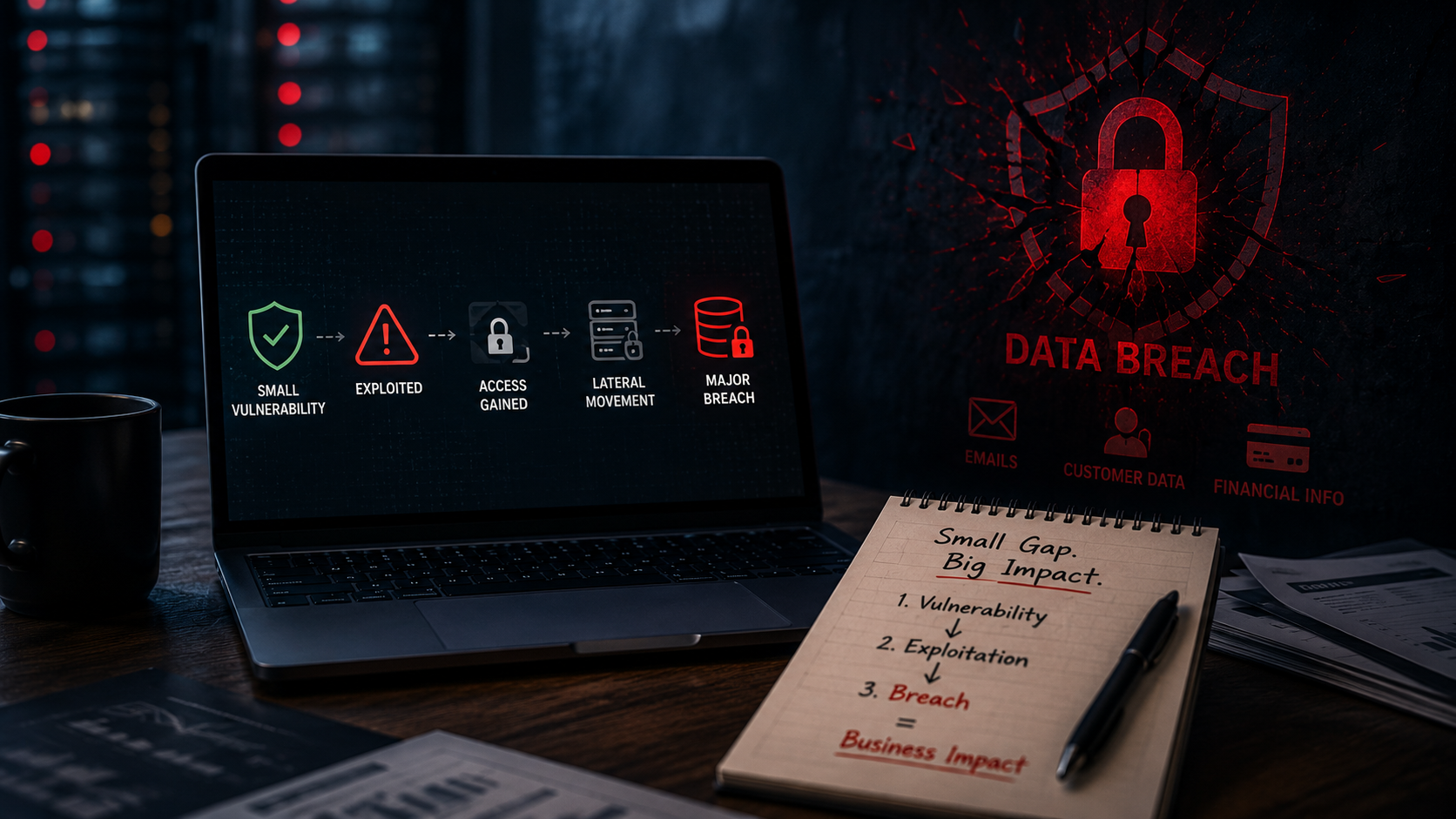
Most cyberattacks don’t start with sophisticated zero-day exploits.
- They start small.
- A missed validation.
- An overlooked API endpoint.
- A minor misconfiguration.
And then—step by step—attackers turn that small gap into a full-scale breach.
In this blog, we’ll walk through a realistic, real-world-inspired incident scenario (based on common breach patterns) to show:
- How a minor vulnerability escalates into a major breach
- The full attack chain used by attackers• Where detection and response failed
- And how Aquiras Systems Pvt. Ltd could have prevented it
The Scenario: A “Low-Risk” API Vulnerability
A mid-sized SaaS company offers a web and mobile platform for managing customer data.
As part of their system:
- APIs handle user data access
- Authentication is token-based
- A Security Information and Event Management system logs activity
During a routine test, a minor issue was identified.
Users could modify an ID parameter in an API request.
It was classified as:
- Low severity
- “No immediate impact”
And deprioritized.
The Small Vulnerability
The Issue: Broken Object Level Authorization (BOLA)
An API endpoint looked like this:
GET /api/v1/customer/1024
Authorization: Bearer <token>
By changing the ID:
/api/v1/customer/1025
The system returned another user’s data.
Why It Was Missed
- Considered “edge case”
- Not caught by automated scans
- QA tested only valid user flows
- No deep API security testing
Stage 1: Reconnaissance
Attackers begin by understanding the system.
What They Do
- Analyze API calls via browser/mobile app
- Intercept requests using proxy tools
- Identify patterns in endpoints
What They Discover
- Predictable ID structure
- Lack of strict authorization checks
At this stage, no alerts are triggered.
Stage 2: Exploitation
The attacker begins testing the vulnerability.
Actions
- Modify user IDs in API requests
- Access other users’ data
- Confirm lack of authorization enforcement
Impact
- Unauthorized data access
- Exposure of sensitive customer information
Stage 3: Automation
Once validated, the attacker scales the attack.
Actions
- Write scripts to enumerate thousands of IDs
- Extract bulk data
- Build a dataset of user information
What’s Missing?
Despite abnormal activity:
- No rate limiting
- No anomaly detection
- No alerts triggered in the SOC
Stage 4: Privilege Escalation
The attacker finds additional weaknesses.
Discovery
- Admin API endpoints follow similar patterns
- Weak access control validation
Exploit
- Manipulate tokens or requests
- Gain elevated privileges
Stage 5: Lateral Movement
With elevated access, the attacker expands control.
Actions
- Access internal systems
- Explore databases
- Identify sensitive assets
Result
- Full visibility into customer data
- Access to critical systems
Stage 6: Data Exfiltration
Now comes the actual breach.
Actions
- Export large volumes of data
- Transfer to external servers
- Avoid detection by throttling requests
Impact
- Massive data leak
- Regulatory violations
- Reputation damage
Stage 7: Delayed Detection
Weeks later, the breach is discovered.
How?
- Customers report suspicious activity• Internal audit detects anomalies
What Failed?
The Security Information and Event Management system:
- Logged activity
- But failed to correlate events
- Generated alerts that were ignored
Where Detection Failed: SOC Gaps
This breach wasn’t just a vulnerability problem—it was a detection failure.
1. Lack of Contextual Monitoring
The SOC saw:
- API requests
- Data access logs
But didn’t understand:
- Abnormal patterns
- Unauthorized behavior
2. Alert Fatigue
Thousands of alerts were generated—but:
- Analysts ignored low-priority alerts
- No prioritization mechanism existed
3. No Threat Hunting
The team relied only on:
- Automated alerts
No proactive investigation was conducted.
4. No API-Specific Monitoring
Traditional monitoring focused on:
- Infrastructure• Web traffic
But ignored:
- API abuse patterns
5. Delayed Response
Even when anomalies were noticed:
- No immediate action was taken
- Incident response was slow
The Root Cause: Multiple Small Failures
This breach wasn’t caused by a single issue.
It was a combination of:
- A minor API vulnerability
- Weak QA processes
- Lack of security testing
- Poor monitoring
- Ineffective response
How This Breach Could Have Been Prevented
Let’s break down how a modern security approach would have stopped this attack.
1. Deep API Penetration Testing
A proper pentest would have:
- Identified BOLA vulnerability
- Tested authorization thoroughly
- Assessed data exposure risks
The issue would have been flagged as critical, not low.
2. Security-Focused QA Testing
QA teams could have:
- Tested ID manipulation
- Validated authorization logic
- Simulated abuse scenarios
The vulnerability would have been caught before release.
3. Rate Limiting & Monitoring
Implementing:
- Rate limits
- API usage monitoring
Would have:
- Prevented mass data extraction
- Triggered alerts early
4. Advanced SOC Monitoring
A mature SOC would:
- Detect abnormal access patterns
- Correlate events across systems
- Prioritize critical alerts
5. Continuous Security Testing
Instead of a one-time pentest:
- Ongoing testing would detect evolving risks
- New vulnerabilities would be identified quickly
6. Red Team Simulation
A red team exercise would:
- Simulate attacker behavior
- Chain vulnerabilities
- Expose real-world risks
How Aquiras Systems Pvt. Ltd Prevents Such Breaches
Most providers focus on isolated services—testing, monitoring, or compliance. Aquiras Systems Pvt. Ltd takes a holistic approach that eliminates gaps across the entire attack lifecycle.
1. Real-World Penetration Testing
Aquiras goes beyond basic scanning:
- Deep API testing
- Business logic analysis
- Attack chain simulation
This ensures even “low-risk” issues are properly evaluated.
2. Security-Driven QA Integration
Aquiras integrates:
- QA testing
- Security validation
Ensuring vulnerabilities are caught during development—not after deployment.
3. Advanced SOC Capabilities
Aquiras enhances detection by:
- Implementing intelligent alert correlation
- Reducing false positives
- Enabling faster response
4. Continuous Security Assessment
Aquiras provides:
- Ongoing testing
- Continuous monitoring
- Adaptive security strategies
5. API & Cloud Security Expertise
Aquiras specializes in:
- API vulnerability detection
- Cloud misconfiguration analysis
- Modern application security
6. Proactive Threat Hunting
Instead of waiting for alerts, Aquiras:
- Actively searches for threats
- Identifies suspicious patterns
- Stops attacks early
7. Business-Focused Risk Prioritization
Aquiras doesn’t just report vulnerabilities—it explains:
- Real-world impact
- Exploitability
- Business risk
Key Takeaways
This incident highlights a critical truth:
There are no “small” vulnerabilities—only underestimated ones.
To prevent similar breaches, organizations must:
- Take API security seriously
- Integrate QA and security testing
- Move beyond automated tools
- Invest in continuous monitoring
- Adopt real-world attack simulations
Final Thoughts
Cybersecurity isn’t about checking boxes—it’s about understanding how attackers think and act.
The difference between a minor issue and a major breach is:
- Context
- Detection
- Response
Organizations that fail to connect these dots remain vulnerable.
Don’t Let a Small Gap Become a Big Breach
If your organization relies on traditional pentesting or basic monitoring, you may already have hidden risks.
Aquiras Systems Pvt. Ltd helps you identify, prioritize, and eliminate vulnerabilities before attackers can exploit them.