

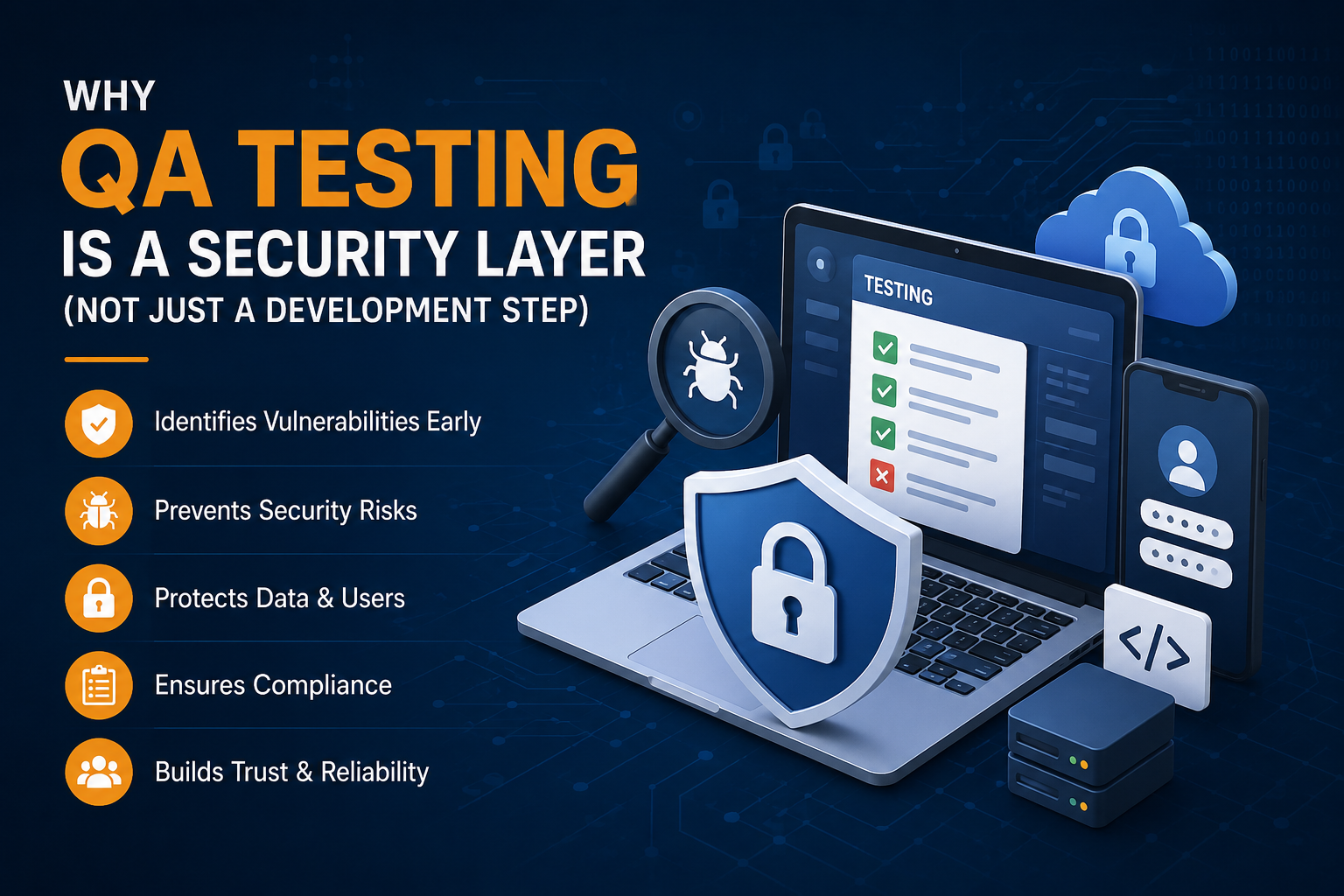
When most organizations think about Quality Assurance (QA), they think about functionality:
- Does the feature work?
- Is the UI behaving correctly?
- Are there any bugs before release?
But here’s the reality many companies overlook:
Poor QA doesn’t just break features—it creates security vulnerabilities.
In today’s threat landscape, QA testing is no longer just about quality—it’s a critical security layer. The line between “bug” and “vulnerability” is thinner than ever, and attackers are actively
In this blog, we’ll explore:
- How poor QA leads to exploitable security issues
- What security-focused testing looks like
- Why shift-left testing is essential
- How QA and security teams should collaborate
- And how Aquiras Systems Pvt. Ltd brings a different approach
The Hidden Risk: When Bugs Become Vulnerabilities
Not all bugs are harmless.
Some bugs:
- Expose sensitive data
- Allow unauthorized access
- Enable attackers to manipulate systems
The Problem
Traditional QA focuses on:
- Functional correctness
- User experience
- Performance
And deprioritized.
But it often ignores:
- Security implications
- Abuse scenarios
- Edge-case exploitation
How Poor QA Leads to Exploitable Bugs
Let’s break down how common QA gaps turn into real security threats.
1. Input Validation Failures
QA tests whether inputs work—not whether they can be abused
Example:
A form accepts user input correctly. QA marks it as “passed.”
But no one tests:
- SQL injection payloads
- Script injections
- Malicious file uploads
Result: Attackers exploit input fields to compromise the system.
2. Broken Authentication Flows
QA verifies:
- Login works
- Password reset functions
But misses:
- Token manipulation
- Session fixation
- Authentication bypass
Result: Attackers gain unauthorized access without triggering alarms.
3. Authorization Gaps
QA ensures users can access their data—but often doesn’t test:
- Access to other users’ data
- Privilege escalation
- Role-based restrictions
Result : Sensitive data exposure and privilege abuse.
4. Business Logic Abuse
QA tests expected workflows—but not unexpected ones.
Example:
- A user completes a purchase flow successfully
- QA marks it as “working”
But no one tests:
- Skipping payment steps
- Manipulating order values
- Reusing transaction tokens
Result: Financial and operational damage.
5. Error Handling and Information Leakage
QA focuses on fixing visible errors—but ignores:
- Debug messages
- Stack traces
- Sensitive system information
Result: Attackers gain insights into system architecture.
The Shift: From Functional QA to Security-Aware QA
To address these risks, QA must evolve.
It’s no longer enough to ask:
“Does it work?”
We must also ask:
“Can it be abused?”
What Are Security-Focused Test Cases?
Security-focused QA integrates attacker thinking into testing.
Key Categories of Security Test Cases
1. Input Abuse Testing
- Test invalid, malicious, and unexpected inputs
- Attempt injection attacks
- Validate sanitization mechanisms
2. Authentication Testing
- Test login bypass attempts
- Validate session handling
- Check token security
3. Authorization Testing
- Attempt horizontal and vertical privilege escalation
- Access restricted resources
- Validate role enforcement
4. Data Protection Testing
- Ensure sensitive data is encrypted
- Verify data masking
- Check secure storage
5. API Security Testing
- Test endpoints with manipulated requests
- Validate access controls
- Check for excessive data exposure
6. Workflow Abuse Testing
- Break user flows intentionally
- Skip steps
- Replay transactions
The Key Difference
- Traditional QA: ✔ Does the system behave correctly?
- Security-focused QA: ✔ Can the system be exploited?
Shift-Left Testing: Catching Security Issues Early
One of the most effective ways to improve security is adopting a shift-left approach.
What Is Shift-Left Testing?
Shift-left means:
Moving testing earlier in the development lifecycle.
Instead of testing at the end, security and QA are integrated from the beginning.
Why It Matters
Fixing vulnerabilities:
- During development → Low cost
- After release → High cost
- After breach → Extremely high cost
Benefits of Shift-Left Testing
- Early detection of vulnerabilities
- Reduced remediation costs
- Faster development cycles
- Improved product quality
How to Implement Shift-Left QA
- Integrate security test cases in development
- Use automated testing in CI/CD pipelines
- Train developers on secure coding practices
- Collaborate with security teams early
QA + Security: A Collaboration That Most Companies Miss
In many organizations:
- QA teams focus on functionality
- Security teams focus on vulnerabilities
These teams often work in silos.
The Problem
This disconnect leads to:
- Missed vulnerabilities
- Duplicate efforts
- Inefficient workflows
The Solution: Collaborative Testing
QA and security teams must work together.
How Collaboration Works
1. Shared Testing Strategy
- Combine functional and security test cases
- Align goals and priorities
2. Knowledge Sharing
- Security teams train QA on attack patterns
- QA teams provide insights into application behavior
3. Integrated Testing Cycles
- Perform joint testing
- Validate both functionality and security simultaneously
4. Continuous Feedback Loop
- Share findings across teams
- Improve processes iteratively
Real-World Example: QA vs Security Mindset
Scenario:
A password reset feature works perfectly.
QA Perspective:
- ✔ Email sent
- ✔ Link works
- ✔ Password updated
- Security Perspective:
- Token can be reused
- No expiration time
- No rate limiting
- Result: Attackers exploit the reset mechanism to take over accounts.
Why Most Companies Fail at Security-Driven QA
- Lack of security awareness in QA teams
- No integration between QA and security
- Over-reliance on automated testing
- Pressure to release quickly
- No structured security testing strategy
How Aquiras Systems Pvt. Ltd Is Different
Most companies treat QA as a final checkpoint.
Aquiras Systems Pvt. Ltd treats QA as a core security layer.
1. Security-First QA Approach
Aquiras integrates:
- Functional testing
- Security testing
- Abuse case validation
This ensures applications are not just working—but secure by design.
2. Deep Business Logic Testing
Aquiras focuses on:
- Real-world usage scenarios
- Workflow manipulation
- Edge-case exploitation
This uncovers vulnerabilities that traditional QA completely misses.
3. Integrated QA + Pentesting
Unlike typical providers, Aquiras combines:
- QA expertise
- Penetration testing methodologies
This creates a hybrid testing model that identifies both bugs and vulnerabilities.
4. Shift-Left Implementation
Aquiras helps organizations:
- Embed QA early in development
- Integrate security into CI/CD
- Detect issues before production
5. API & Modern Application Focus
Aquiras specializes in:
- API testing
- Microservices environments
- Cloud-native applications
Ensuring security across modern architectures.
6. Continuous Testing Model
Instead of one-time QA cycles, Aquiras offers:
- Ongoing testing
- Continuous improvement
- Adaptive security validation
7. Actionable Reporting
Aquiras provides:
- Clear issue prioritization
- Security impact analysis
- Practical remediation steps
Final Thoughts
QA is no longer just about quality—it’s about security, reliability, and trust.
Organizations that treat QA as a checkbox activity risk:
- Data breaches
- Financial loss
- Reputation damage
But those that evolve QA into a security layer gain:
- Stronger applications
- Reduced vulnerabilities
- Faster, safer releases
The Future of QA Is Security-Driven
To stay ahead, companies must:
- Integrate security into QA
- Adopt shift-left testing
- Foster collaboration between teams
- Think like attackers—not just testers
Ready to Transform Your QA Strategy?
If your QA process is only focused on functionality, you’re leaving your business exposed.
Aquiras Systems Pvt. Ltd helps organizations turn QA into a powerful security layer—ensuring your applications are both high-quality and secure.