

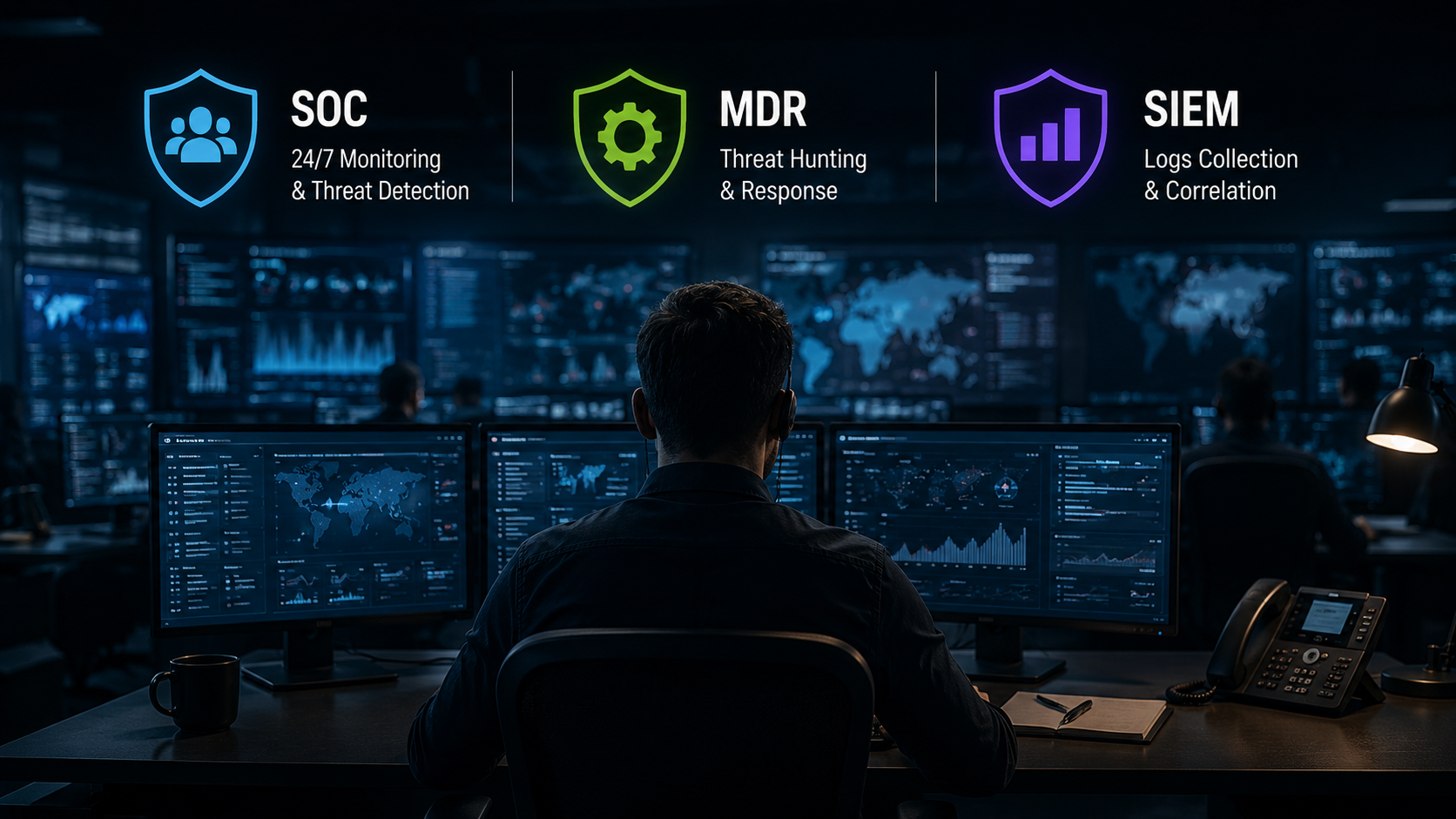
Cybersecurity today is filled with buzzwords—SOC, MDR, SIEM—each promising better protection, faster detection, and stronger response capabilities. But for many business leaders, these terms create more confusion than clarity.
If you’re a CTO, CISO, or founder trying to decide how to protect your organization, you’ve Do we need to build a SOC?
- Do we need to build a SOC?
- Is SIEM enough?
- Should we outsource to MDR?
This blog breaks down the differences, costs, and real-world use cases to help you make the right
decision.
Understanding the Basics: SOC vs MDR vs SIEM
Before diving deeper, let’s clarify what each term actually means.
What Is a SOC (Security Operations Center)?
A Security Operations Center (SOC) is a centralized function responsible for:
- Monitoring security events
- Detecting threats
- Investigating incidents
- Responding to attacks
A SOC typically includes:
- Security analysts
- Incident responders
- Threat intelligence teams
- Monitoring tools (like SIEM)
What Is SIEM (Security Information and Event Management)?
Security Information and Event Management (SIEM) is a technology platform—not a service.
It:
- Collects logs from multiple systems
- Correlates events
- Generates alerts for suspicious activity
- Provides visibility into your environment
Popular SIEM tools include:
- Splunk
- IBM QRadar
- Microsoft Sentinel
Important:
A SIEM does not act on its own. It needs skilled analysts to interpret alerts and respond.What Is MDR (Managed Detection & Response)?
Managed Detection and Response (MDR) is a fully managed security service.
It provides:
- 24/7 threat monitoring
- Detection and analysis
- Incident response
- Threat hunting
In simple terms:
MDR = SOC capabilities delivered as a service
Key Differences: SOC vs MDR vs SIEM
Let’s break this down in a way that actually helps decision-making.
1.Ownership
- SOC: Built and managed internally
- SIEM: Tool owned by your organization
- MDR: Outsourced to a third-party provider
2.Function
- SOC: People + processes + tools
- SIEM: Technology platform
- MDR: Managed service
3.Complexity
- SOC: High (requires team, processes, tools)
- SIEM: Medium to high (needs configuration and tuning)
- MDR: Low (handled by provider)
4.Response Capability
- SOC: Full control
- SIEM: No response (only alerts)
- MDR: Active response included
5.Time to Deploy
- SOC: Months to years
- SIEM: Weeks to months
- MDR: Days to weeks
The Biggest Misconception: “We Have SIEM, So We’re
Secure”
This is one of the most dangerous assumptions organizations make.
A SIEM can generate thousands of alerts daily—but:
- Who reviews them?
- Who investigates anomalies?
- Who responds to incidents?
Without skilled analysts, SIEM becomes:
An expensive logging system—not a security solution
Cost vs Capability Breakdown
Let’s talk about what really matters: ROI and operational impact.
Building an In-House SOC
Costs:
- Hiring skilled analysts (expensive and scarce)
- 24/7 staffing (multiple shifts required)
- Infrastructure and tools
- Continuous training
Estimated Cost:
High (often ₹1–5+ crore annually for mature SOCs)
Benefits:
- Full control
- Custom processes
- Deep integration with business
Challenges:
- Talent shortage
- High operational overhead
- Burnout and turnover
Implementing SIEM
Costs:
- Licensing fees
- Infrastructure (cloud or on-prem)
- Integration and setup
- Ongoing tuning
Estimated Cost:
Medium to high
Benefits:
- Centralized visibility
- Compliance support
- Data correlation
Challenges:
- Requires skilled team
- High false positives
- Complex maintenance
Using MDR Services
Costs:
- Subscription-based pricing
- Lower upfront investment
Estimated Cost:
Moderate and predictable
Benefits:
- Immediate access to expertise
- 24/7 monitoring
- Faster incident response
- Reduced operational burden
Challenges:
- Less direct control
- Dependency on provider quality
When Should You Build a SOC?
Building a SOC makes sense if:
- You are a large enterprise
- You have strict regulatory requirements
- You can invest heavily in talent and infrastructure
- You need full control over security operations
Banks, telecom companies, large SaaS enterprises
When Should You Use SIEM?
SIEM is useful if:
- You need centralized logging and visibility
- You have a security team to manage it
- You’re preparing for compliance audits
When Should You Choose MDR?
MDR is ideal if:
- You lack an in-house security team
- You need immediate protection
- You want predictable costs
- You want expert-driven threat detection
Startups, mid-sized companies, growing enterprises
A Simple Decision Framework
Here’s a practical way to decide:
Step 1: Assess Your Maturity
- No security team → MDR
- Small team → MDR + SIEM
- Mature team → SOC + SIEM
Step 2: Evaluate Budget
- Limited budget → MDR
- Moderate budget → SIEM + partial SOC
- High budget → Full SOC
Step 3: Consider Risk Level
- High-risk industry → SOC or MDR with advanced capabilities
- Moderate risk → MDR
- Low risk → SIEM + basic monitoring
Step 4: Time to Deployment
- Need immediate protection → MDR
- Can invest time → SOC
The Real-World Approach: Hybrid Models
Most modern organizations don’t choose just one—they combine:
- SIEM for visibility
- MDR for monitoring and response
- Partial SOC for internal oversight
This hybrid approach offers:
- Flexibility
- Scalability
- Cost efficiency
How Aquiras Systems Pvt. Ltd Is Different
Many providers offer SOC, MDR, or SIEM as isolated services. Aquiras Systems Pvt. Ltd, however, takes a more strategic and integrated approach.1.Not Just Tools—Complete Security Strategy
Aquiras doesn’t just deploy SIEM tools—it ensures:
- Proper configuration
- Noise reduction (fewer false positives)
- Actionable alerting
2.SOC + MDR Hybrid Expertise
Instead of forcing a one-size-fits-all model, Aquiras:
- Helps you decide build vs outsource
- Offers flexible SOC support
- Provides MDR-like capabilities with customization
3.Business-Aligned Security
Aquiras focuses on:
- Your industry risks
- Your infrastructure
- Your business priorities
4.Faster Detection, Smarter Response
Unlike traditional providers, Aquiras:
- Uses real-world attack scenarios
- Implements proactive threat hunting
- Reduces response time significantly
5.Cost-Optimized Solutions
Aquiras helps organizations:
- Avoid over-investing in unnecessary tools
- Optimize existing security stack
- Achieve maximum ROI
6.Continuous Improvement Model
Security isn’t static—and neither is Aquiras.
They provide:
- Continuous monitoring
- Ongoing optimization
- Adaptive security strategies
Final Thoughts
Choosing between SOC, MDR, and SIEM isn’t about picking the “best” option—it’s about choosing the right fit for your business.- SIEM gives you visibility
- SOC gives you control
- MDR gives you expertise
But none of them alone guarantee security.
The Smart Approach
To stay ahead of modern threats, organizations need:
- The right combination of tools and services
- Continuous monitoring and response
- Real-world threat intelligence
- Strategic guidance