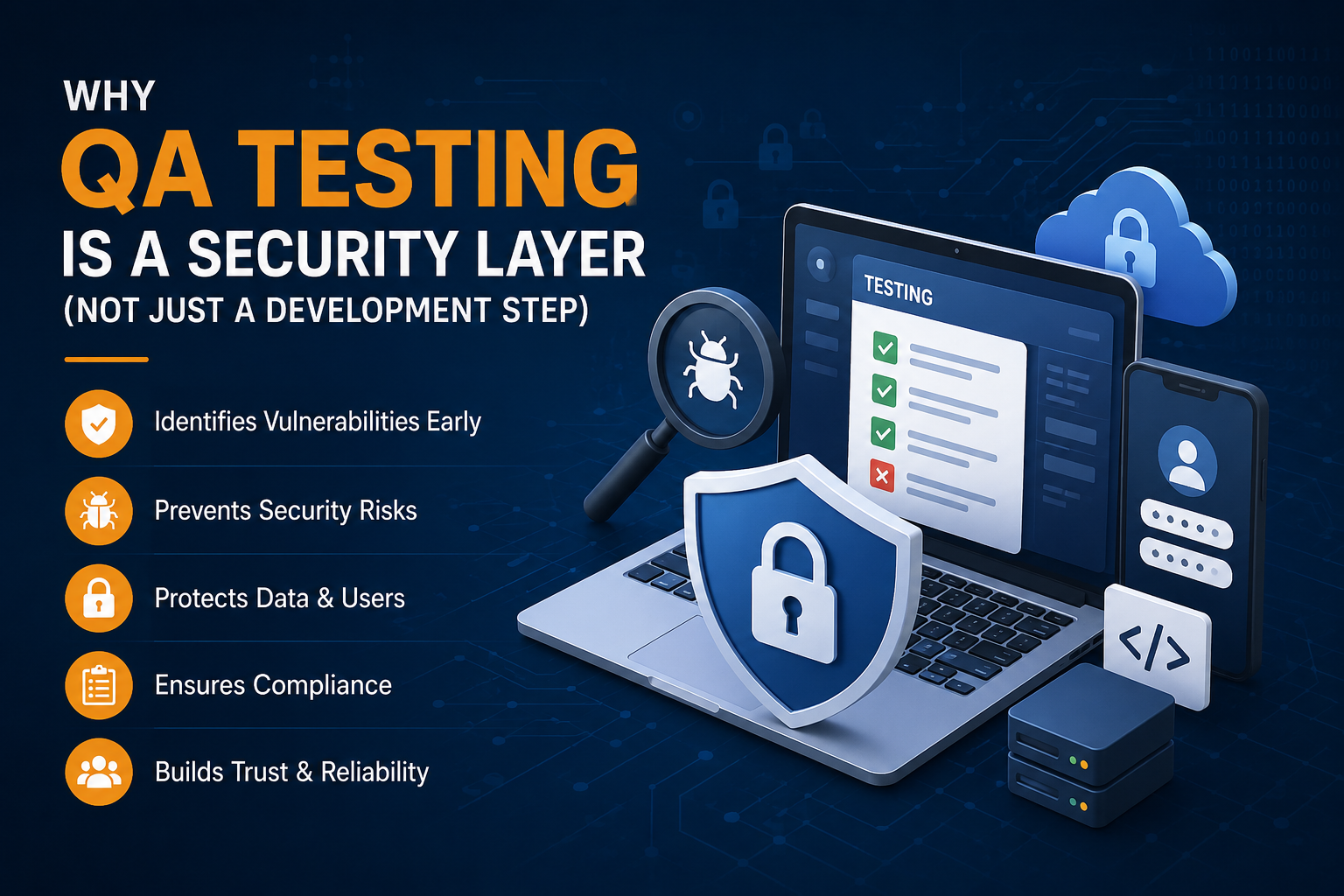
Why QA Testing Is a Security Layer (Not Justa Development Step)

No comments

When most organizations think about Quality Assurance (QA), they think about functionality:

  • Does the feature work?
  • Is the UI behaving correctly?
  • Are there any bugs before release?

But here’s the reality many companies overlook:

Poor QA doesn’t just break features—it creates security vulnerabilities.

In today’s threat landscape, QA testing is no longer just about quality—it’s a critical security layer. The line between “bug” and “vulnerability” is thinner than ever, and attackers are actively

In this blog, we’ll explore:

  • How poor QA leads to exploitable security issues
  • What security-focused testing looks like
  • Why shift-left testing is essential
  • How QA and security teams should collaborate
  • And how Aquiras Systems Pvt. Ltd brings a different approach

The Hidden Risk: When Bugs Become Vulnerabilities

Not all bugs are harmless.

Some bugs:

  • Expose sensitive data
  • Allow unauthorized access
  • Enable attackers to manipulate systems

The Problem

Traditional QA focuses on:

  • Functional correctness
  • User experience
  • Performance

And deprioritized.

But it often ignores:

  • Security implications
  • Abuse scenarios
  • Edge-case exploitation

How Poor QA Leads to Exploitable Bugs

Let’s break down how common QA gaps turn into real security threats.

1. Input Validation Failures

QA tests whether inputs work—not whether they can be abused

Example:

A form accepts user input correctly. QA marks it as “passed.”

But no one tests:

  • SQL injection payloads
  • Script injections
  • Malicious file uploads

Result: Attackers exploit input fields to compromise the system.

2. Broken Authentication Flows

QA verifies:

  • Login works
  • Password reset functions

But misses:

  • Token manipulation
  • Session fixation
  • Authentication bypass

Result: Attackers gain unauthorized access without triggering alarms.

3. Authorization Gaps

QA ensures users can access their data—but often doesn’t test:

  • Access to other users’ data
  • Privilege escalation
  • Role-based restrictions

Result : Sensitive data exposure and privilege abuse.

4. Business Logic Abuse

QA tests expected workflows—but not unexpected ones.

Example:

  • A user completes a purchase flow successfully
  • QA marks it as “working”

But no one tests:

  • Skipping payment steps
  • Manipulating order values
  • Reusing transaction tokens

Result: Financial and operational damage.

5. Error Handling and Information Leakage

QA focuses on fixing visible errors—but ignores:

  • Debug messages
  • Stack traces
  • Sensitive system information

Result: Attackers gain insights into system architecture.

The Shift: From Functional QA to Security-Aware QA

To address these risks, QA must evolve.

It’s no longer enough to ask:

“Does it work?”

We must also ask:

“Can it be abused?”

What Are Security-Focused Test Cases?

Security-focused QA integrates attacker thinking into testing.

Key Categories of Security Test Cases

1. Input Abuse Testing

  • Test invalid, malicious, and unexpected inputs
  • Attempt injection attacks
  • Validate sanitization mechanisms

2. Authentication Testing

  • Test login bypass attempts
  • Validate session handling
  • Check token security

3. Authorization Testing

  • Attempt horizontal and vertical privilege escalation
  • Access restricted resources
  • Validate role enforcement

4. Data Protection Testing

  • Ensure sensitive data is encrypted
  • Verify data masking
  • Check secure storage

5. API Security Testing

  • Test endpoints with manipulated requests
  • Validate access controls
  • Check for excessive data exposure

6. Workflow Abuse Testing

  • Break user flows intentionally
  • Skip steps
  • Replay transactions

The Key Difference

  • Traditional QA: ✔ Does the system behave correctly?
  • Security-focused QA: ✔ Can the system be exploited?

Shift-Left Testing: Catching Security Issues Early

One of the most effective ways to improve security is adopting a shift-left approach.

What Is Shift-Left Testing?

Shift-left means:

Moving testing earlier in the development lifecycle.

Instead of testing at the end, security and QA are integrated from the beginning.

Why It Matters

Fixing vulnerabilities:

  • During development → Low cost
  • After release → High cost
  • After breach → Extremely high cost

Benefits of Shift-Left Testing

  • Early detection of vulnerabilities
  • Reduced remediation costs
  • Faster development cycles
  • Improved product quality

How to Implement Shift-Left QA

  • Integrate security test cases in development
  • Use automated testing in CI/CD pipelines
  • Train developers on secure coding practices
  • Collaborate with security teams early

QA + Security: A Collaboration That Most Companies Miss

In many organizations:

  • QA teams focus on functionality
  • Security teams focus on vulnerabilities

These teams often work in silos.

The Problem

This disconnect leads to:

  • Missed vulnerabilities
  • Duplicate efforts
  • Inefficient workflows

The Solution: Collaborative Testing

QA and security teams must work together.

How Collaboration Works

1. Shared Testing Strategy

  • Combine functional and security test cases
  • Align goals and priorities

2. Knowledge Sharing

  •  Security teams train QA on attack patterns
  • QA teams provide insights into application behavior

3. Integrated Testing Cycles

  • Perform joint testing
  • Validate both functionality and security simultaneously

4. Continuous Feedback Loop

  • Share findings across teams
  • Improve processes iteratively

Real-World Example: QA vs Security Mindset

Scenario:

A password reset feature works perfectly.

QA Perspective:

  • ✔ Email sent
  • ✔ Link works
  • ✔ Password updated
  • Security Perspective:
  • Token can be reused
  • No expiration time
  • No rate limiting
  • Result: Attackers exploit the reset mechanism to take over accounts.

Why Most Companies Fail at Security-Driven QA

  • Lack of security awareness in QA teams
  • No integration between QA and security
  • Over-reliance on automated testing
  • Pressure to release quickly
  • No structured security testing strategy

How Aquiras Systems Pvt. Ltd Is Different

Most companies treat QA as a final checkpoint.

Aquiras Systems Pvt. Ltd treats QA as a core security layer.

1. Security-First QA Approach

Aquiras integrates:

  • Functional testing
  • Security testing
  • Abuse case validation

This ensures applications are not just working—but secure by design.

2. Deep Business Logic Testing

Aquiras focuses on:

  • Real-world usage scenarios
  • Workflow manipulation
  • Edge-case exploitation

This uncovers vulnerabilities that traditional QA completely misses.

3. Integrated QA + Pentesting

Unlike typical providers, Aquiras combines:

  • QA expertise
  • Penetration testing methodologies

This creates a hybrid testing model that identifies both bugs and vulnerabilities.

4. Shift-Left Implementation

Aquiras helps organizations:

  • Embed QA early in development
  • Integrate security into CI/CD
  • Detect issues before production

5. API & Modern Application Focus

Aquiras specializes in:

  • API testing
  • Microservices environments
  • Cloud-native applications

Ensuring security across modern architectures.

6. Continuous Testing Model

Instead of one-time QA cycles, Aquiras offers:

  • Ongoing testing
  • Continuous improvement
  • Adaptive security validation

7. Actionable Reporting

Aquiras provides:

  • Clear issue prioritization
  • Security impact analysis
  • Practical remediation steps

Final Thoughts

QA is no longer just about quality—it’s about security, reliability, and trust.

Organizations that treat QA as a checkbox activity risk:

  • Data breaches
  • Financial loss
  • Reputation damage

But those that evolve QA into a security layer gain:

  • Stronger applications
  • Reduced vulnerabilities
  • Faster, safer releases

The Future of QA Is Security-Driven

To stay ahead, companies must:

  • Integrate security into QA
  • Adopt shift-left testing
  • Foster collaboration between teams
  • Think like attackers—not just testers

Ready to Transform Your QA Strategy?

If your QA process is only focused on functionality, you’re leaving your business exposed.

Aquiras Systems Pvt. Ltd helps organizations turn QA into a powerful security layer—ensuring your applications are both high-quality and secure.
aquirasWhy QA Testing Is a Security Layer (Not Justa Development Step)
read more

The Hidden Gaps in Modern Penetration Testing That Most Companies Miss

No comments

In an era where cyber threats are evolving faster than ever, penetration testing (pentesting) has become a cornerstone of organizational security. Companies invest heavily in annual or quarterly pentests, believing they are safeguarding their applications, infrastructure, and data from real world attacks.

But here’s the uncomfortable truth:

Most penetration testing engagements leave critical gaps—gaps that attackers are actively exploiting every day.

While traditional pentesting provides value, it often fails to reflect how modern attackers operate. As a result, businesses end up with a false sense of security, assuming they are protected when, in reality, significant vulnerabilities remain undiscovered.

In this blog, we’ll explore:

  • Why automated scans are not enough
  • The most overlooked vulnerabilities in modern environments
  • Real-world examples of missed risks
  • How penetration testing must evolve
  • And how Aquiras Systems Pvt. Ltd approaches security differently

The Illusion of Security: Why Traditional Pentesting Isn’t
Enough

Traditional penetration testing typically follows a structured and time-bound approach:

  • Run automated vulnerability scanners
  • Perform limited manual testing
  • Deliver a report with findings and severity ratings

While this process identifies known vulnerabilities, it rarely simulates real attacker behavior.

The Key Problem

Attackers don’t follow predefined methodologies. They:

  • Think creatively
  • Chain multiple low-risk issues into critical exploits
  • Target logic, not just code
  • Exploit human and process weaknesses

Most pentests, however:

  • Focus on known vulnerabilities (CVEs)
  • Operate within tight time constraints
  • Lack deep business context
  • Treat applications as static systems
This creates a dangerous gap between compliance-driven testing and real-world security.

Why Automated Scans Are Not Enough

Automated tools are an essential part of security testing—but relying on them alone is a major mistake.

What Automated Scanners Do Well

  • Identify known vulnerabilities
  • Detect outdated software versions
  • Highlight misconfigurations
  • Provide quick coverage

Where They Fail

Automated scanners cannot:

  • Understand business logic
  • Detect complex authentication flaws
  • Identify chained attack paths
  • Analyze application workflows
  • Simulate attacker intent

A Simple Example

An automated tool might confirm:
“User cannot access admin panel directly.”
But it won’t test:
“Can a user manipulate a request to escalate privileges indirectly?”
That’s where real attackers operate—and where traditional pentests often fall short.

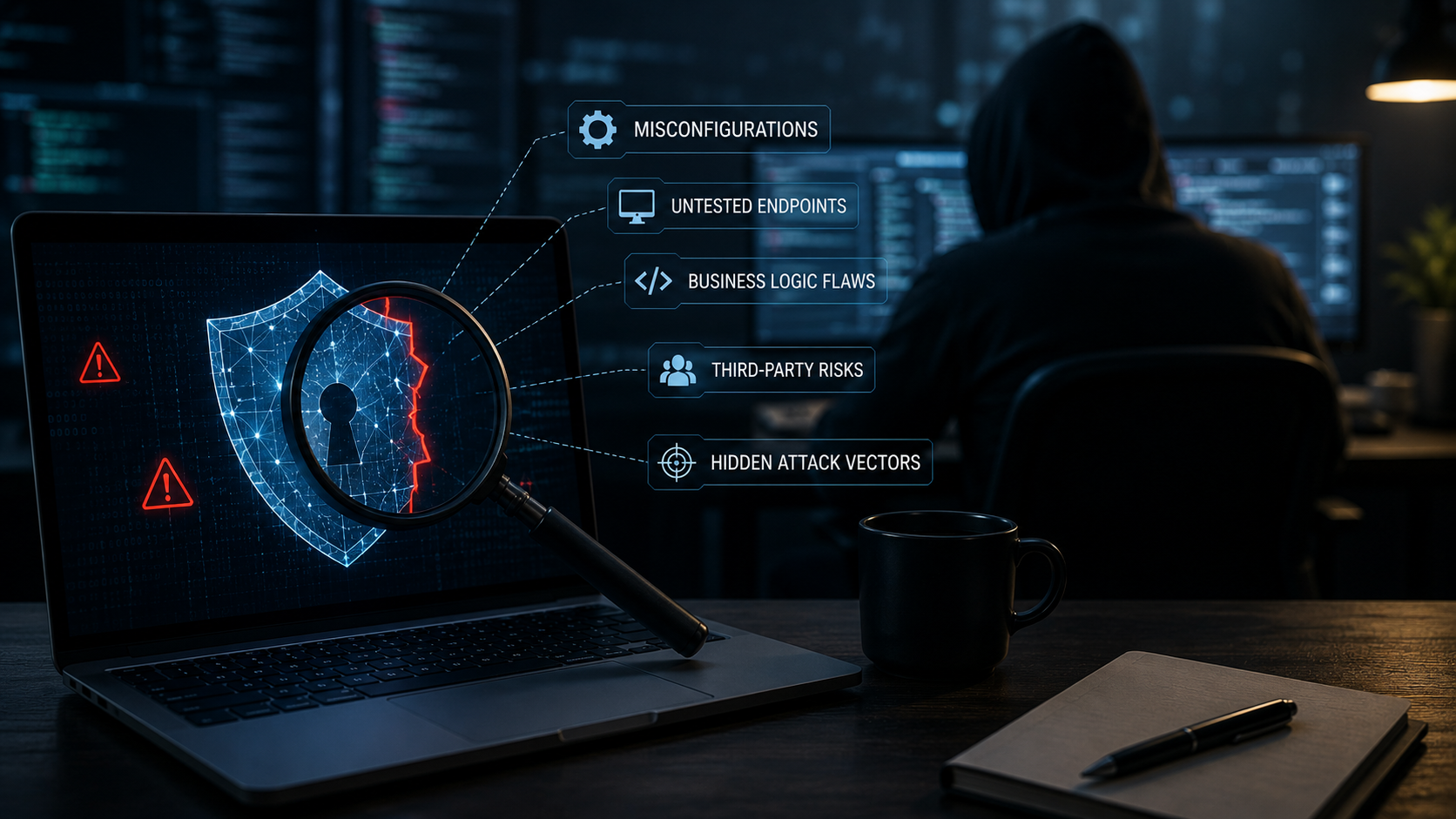
Gap #1: Business Logic Vulnerabilities

Business logic vulnerabilities are among the most critical—and most frequently missed—security issues.

These flaws arise not from coding errors, but from how an application is designed to function.

Why They Matter

Unlike technical vulnerabilities, business logic flaws:

  • Are unique to each application
  • Cannot be detected by automated tools
  • Often lead to direct financial loss
  • Are highly exploitable

Real-World Examples

1.Payment Bypass in E-commerce

An attacker modifies the payment request:

  • Changes the amount to ₹1
  • Completes the purchase successfully

No vulnerability scanner will catch this—it requires understanding the payment workflow.

2.Coupon Abuse

A discount code intended for single use can be applied multiple times by manipulating API requests.

3.Privilege Escalation via Workflow Manipulation

A normal user gains admin access by skipping steps in a multi-stage approval process.

Why Traditional Pentests Miss This

  • Limited testing time
  • Lack of domain knowledge
  • Over-reliance on automated tools
  • Focus on technical vulnerabilities over functional ones

Gap #2: API Security Blind Spots

Modern applications rely heavily on APIs—especially with mobile apps, SaaS platforms, and
microservices architectures.

Unfortunately, API security is one of the weakest areas in traditional pentesting.

Common API Vulnerabilities

Broken Object Level Authorization (BOLA)

An attacker changes an ID in the API request:

/api/user/123 → /api/user/124

And gains access to another user’s data.

2.Excessive Data Exposure

APIs return more data than necessary, exposing sensitive information.

3.Weak Authentication Mechanisms

  • Token reuse
  • Missing validation
  • Poor session management

4.Lack of Rate Limiting

Enables brute-force or enumeration attacks.

Why APIs Are Often Ignored

  • APIs require specialized testing tools
  • Documentation may be incomplete
  • Testers focus more on web interfaces
  • Complex authentication flows are hard to simulate

Real-World Scenario

A fintech app exposes transaction data via an API.
The web interface restricts access—but the API does not enforce proper authorization.
Result:
Attackers extract sensitive financial data without triggering alerts.

Gap #3: Cloud Misconfigurations

As organizations move to AWS, Azure, and GCP, cloud security has become a critical concern.
Yet many pentests still treat infrastructure as a secondary focus.

Common Cloud Security Issues

  • Publicly exposed storage buckets
  • Misconfigured IAM roles
  • Over-permissive access policies
  • Lack of network segmentation
  • Unsecured APIs and endpoints

Real-World Example

A company stores sensitive customer data in a cloud storage bucket.

Due to a misconfiguration:

  • The bucket is publicly accessible
  • No authentication is required

This type of issue has caused massive data breaches globally.

Why Traditional Pentesting Misses Cloud Risks

  • Limited visibility into cloud architecture
  • Lack of cloud-specific expertise
  • Focus on application layer only
  • No continuous monitoring

The Bigger Issue: Point-in-Time Testing

Most pentests are conducted:

  • Once a year
  • Before compliance audits
  • After major releases

But modern environments change constantly:

  • New features are deployed weekly
  • APIs are updated frequently
  • Infrastructure is dynamic

The Problem

A pentest reflects security at a single point in time.

But attackers exploit vulnerabilities between tests, not during them.


How Modern Penetration Testing Should Evolve

To address these gaps, organizations must move beyond traditional pentesting.

1.Continuous Security Testing

Instead of annual assessments:

  • Test continuously
  • Integrate security into CI/CD pipelines
  • Monitor changes in real-time

2.Red Teaming

Red teaming simulates real-world attacks:

  • No predefined scope limitations
  • Focus on attacker objectives
  • Combines technical and social engineering tactics
This approach provides a realistic assessment of security posture.

3.Context-Driven Testing

Security testing must align with:

  • Business logic
  • User workflows
  • Industry-specific risks

This ensures vulnerabilities are identified in real-world scenarios.

4.API-First Security Approach

Organizations must:

  • Treat APIs as primary attack surfaces
  • Conduct deep API testing
  • Validate authentication and authorization rigorously

5.Cloud-Native Security Assessments

Modern pentesting must include:

  • IAM reviews
  • Configuration audits
  • Infrastructure security testing
  • Continuous cloud monitoring

How Aquiras Systems Pvt. Ltd Is Different

While many companies offer penetration testing as a checklist-driven service, Aquiras Systems Pvt. Ltd takes a fundamentally different approach.

1.Beyond Automated Scanning

Aquiras combines:

  • Advanced manual testing
  • Real attacker methodologies
  • Deep application understanding
This ensures vulnerabilities are not just detected—but truly understood and validated.

2.Business Logic-Centric Testing

Unlike conventional firms, Aquiras:

  • Analyzes real user workflows
  • Identifies logic flaws unique to your business
  • Simulates real-world abuse scenarios

This approach uncovers vulnerabilities that most providers completely miss.

3.Specialized API Security Testing

Aquiras performs:

  • Deep API penetration testing
  • Authentication and authorization validation
  • Data exposure analysis
  • Abuse case simulation

This ensures your APIs are secured against modern threats.

4.Cloud Security Expertise

Aquiras goes beyond surface-level testing by:

  • Reviewing IAM configurations
  • Identifying misconfigurations
  • Assessing cloud architecture security
  • Testing real-world exploit scenarios

5.Continuous & Adaptive Testing

Instead of one-time engagements, Aquiras promotes:

  • Continuous security assessments
  • Ongoing vulnerability discovery
  • Adaptive testing aligned with your development lifecycle

6.Real-World Attack Simulation (Red Teaming)

Aquiras simulates actual attacker behavior by:

  • Chaining vulnerabilities
  • Testing detection capabilities
  • Evaluating incident response readiness

7.Actionable, Business-Focused Reporting

Rather than overwhelming clients with technical jargon, Aquiras provides:

  • Clear risk prioritization
  • Business impact analysis
  • Practical remediation steps

Final Thoughts

Penetration testing is essential—but how it’s done matters more than whether it’s done.

Relying solely on traditional methods leaves organizations exposed to:

  • Business logic flaws
  • API vulnerabilities
  • Cloud misconfigurations
  • Advanced attack techniques

To stay ahead of modern threats, companies must adopt:

  • Continuous testing
  • Real-world attack simulation
  • Context-driven security assessments

Ready to Close the Gaps?

If your organization is relying on outdated pentesting approaches, it’s time to rethink your
strategy.

Aquiras Systems Pvt. Ltd helps businesses move beyond checkbox security—toward real, measurable protection.

aquirasThe Hidden Gaps in Modern Penetration Testing That Most Companies Miss
read more

SOC vs MDR vs SIEM: What Does Your Business Actually Need?

No comments

Cybersecurity today is filled with buzzwords—SOC, MDR, SIEM—each promising better protection, faster detection, and stronger response capabilities. But for many business leaders, these terms create more confusion than clarity.

If you’re a CTO, CISO, or founder trying to decide how to protect your organization, you’ve Do we need to build a SOC?

  • Do we need to build a SOC?
  • Is SIEM enough?
  • Should we outsource to MDR?
The truth is, there’s no one-size-fits-all answer. Each approach serves a different purpose, and choosing the wrong one can lead to wasted budget—or worse, undetected threats.

This blog breaks down the differences, costs, and real-world use cases to help you make the right
decision.

Understanding the Basics: SOC vs MDR vs SIEM

Before diving deeper, let’s clarify what each term actually means.

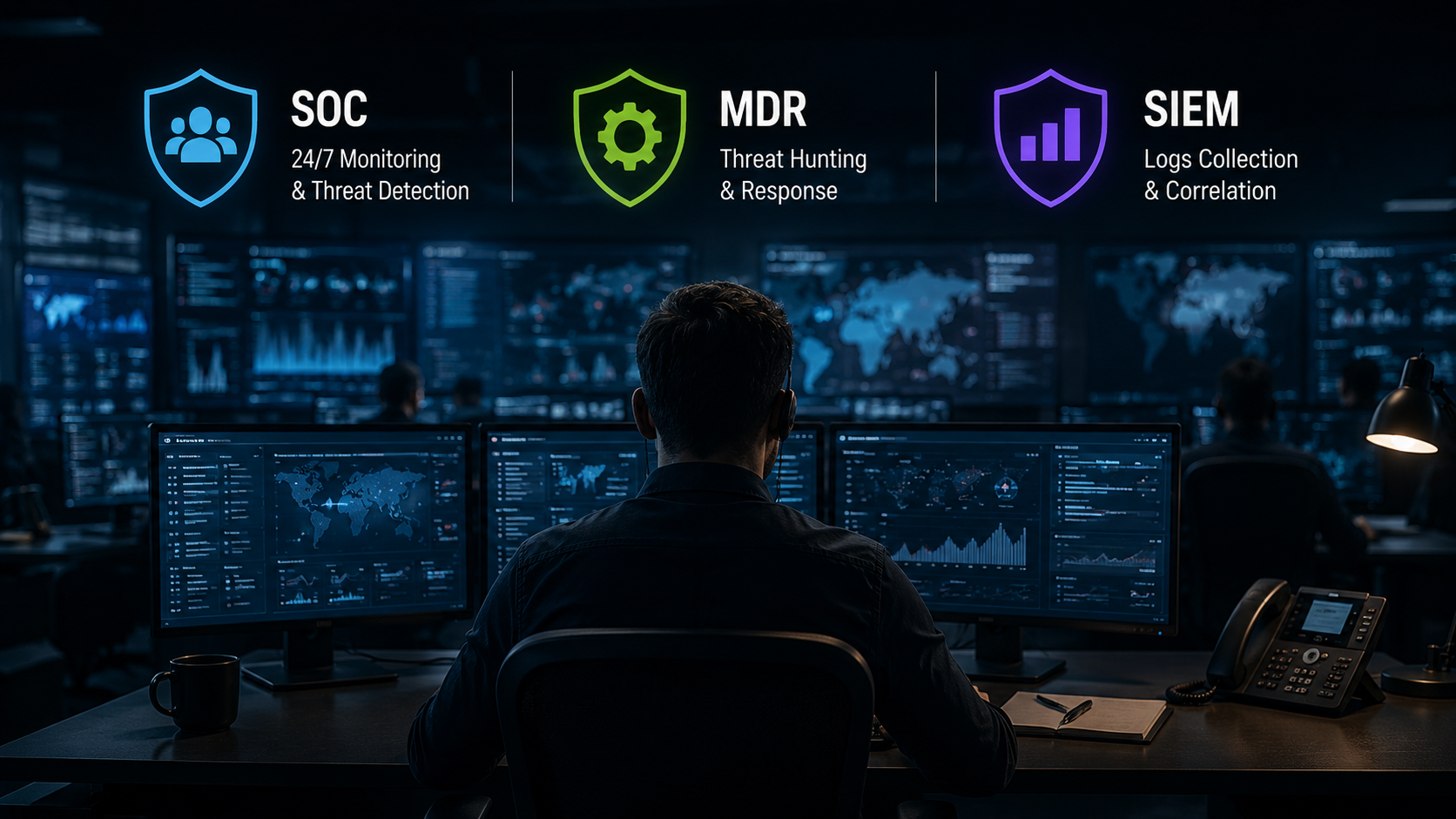
What Is a SOC (Security Operations Center)?

A Security Operations Center (SOC) is a centralized function responsible for:

  • Monitoring security events
  • Detecting threats
  • Investigating incidents
  • Responding to attacks
Think of it as your organization’s cybersecurity command center, operating 24/7.

A SOC typically includes:

  • Security analysts
  • Incident responders
  • Threat intelligence teams
  • Monitoring tools (like SIEM)

What Is SIEM (Security Information and Event Management)?

Security Information and Event Management (SIEM) is a technology platform—not a service.
It:

  • Collects logs from multiple systems
  • Correlates events
  • Generates alerts for suspicious activity
  • Provides visibility into your environment

Popular SIEM tools include:

  • Splunk
  • IBM QRadar
  • Microsoft Sentinel

Important:

A SIEM does not act on its own. It needs skilled analysts to interpret alerts and respond.

What Is MDR (Managed Detection & Response)?

Managed Detection and Response (MDR) is a fully managed security service.

It provides:

  • 24/7 threat monitoring
  • Detection and analysis
  • Incident response
  • Threat hunting

In simple terms:

MDR = SOC capabilities delivered as a service

Key Differences: SOC vs MDR vs SIEM

Let’s break this down in a way that actually helps decision-making.

1.Ownership

  • SOC: Built and managed internally
  • SIEM: Tool owned by your organization
  • MDR: Outsourced to a third-party provider

2.Function

  • SOC: People + processes + tools
  • SIEM: Technology platform
  • MDR: Managed service

3.Complexity

  • SOC: High (requires team, processes, tools)
  • SIEM: Medium to high (needs configuration and tuning)
  • MDR: Low (handled by provider)

4.Response Capability

  • SOC: Full control
  • SIEM: No response (only alerts)
  • MDR: Active response included

5.Time to Deploy

  • SOC: Months to years
  • SIEM: Weeks to months
  • MDR: Days to weeks

The Biggest Misconception: “We Have SIEM, So We’re
Secure”

This is one of the most dangerous assumptions organizations make.

A SIEM can generate thousands of alerts daily—but:

  • Who reviews them?
  • Who investigates anomalies?
  • Who responds to incidents?

Without skilled analysts, SIEM becomes:

An expensive logging system—not a security solution

Cost vs Capability Breakdown

Let’s talk about what really matters: ROI and operational impact.

Building an In-House SOC

Costs:
  • Hiring skilled analysts (expensive and scarce)
  • 24/7 staffing (multiple shifts required)
  • Infrastructure and tools
  • Continuous training

Estimated Cost:
High (often ₹1–5+ crore annually for mature SOCs)

Benefits:
  • Full control
  • Custom processes
  • Deep integration with business
Challenges:
  • Talent shortage
  • High operational overhead
  • Burnout and turnover

Implementing SIEM

Costs:

  • Licensing fees
  • Infrastructure (cloud or on-prem)
  • Integration and setup
  • Ongoing tuning

Estimated Cost:
Medium to high

Benefits:
  • Centralized visibility
  • Compliance support
  • Data correlation
Challenges:
  • Requires skilled team
  • High false positives
  • Complex maintenance

Using MDR Services

Costs:
  • Subscription-based pricing
  • Lower upfront investment

Estimated Cost:
Moderate and predictable

Benefits:
  • Immediate access to expertise
  • 24/7 monitoring
  • Faster incident response
  • Reduced operational burden
Challenges:
  • Less direct control
  • Dependency on provider quality

When Should You Build a SOC?

Building a SOC makes sense if:

  • You are a large enterprise
  • You have strict regulatory requirements
  • You can invest heavily in talent and infrastructure
  • You need full control over security operations

Banks, telecom companies, large SaaS enterprises

When Should You Use SIEM?

SIEM is useful if:

  • You need centralized logging and visibility
  • You have a security team to manage it
  • You’re preparing for compliance audits
SIEM should not be your only security strategy.

When Should You Choose MDR?

MDR is ideal if:

  • You lack an in-house security team
  • You need immediate protection
  • You want predictable costs
  • You want expert-driven threat detection

Startups, mid-sized companies, growing enterprises

A Simple Decision Framework

Here’s a practical way to decide:

Step 1: Assess Your Maturity

  • No security team → MDR
  • Small team → MDR + SIEM
  • Mature team → SOC + SIEM

Step 2: Evaluate Budget

  • Limited budget → MDR
  • Moderate budget → SIEM + partial SOC
  • High budget → Full SOC

Step 3: Consider Risk Level

  • High-risk industry → SOC or MDR with advanced capabilities
  • Moderate risk → MDR
  • Low risk → SIEM + basic monitoring

Step 4: Time to Deployment

  • Need immediate protection → MDR
  • Can invest time → SOC

The Real-World Approach: Hybrid Models

Most modern organizations don’t choose just one—they combine:

  • SIEM for visibility
  • MDR for monitoring and response
  • Partial SOC for internal oversight

This hybrid approach offers:

  • Flexibility
  • Scalability
  • Cost efficiency

How Aquiras Systems Pvt. Ltd Is Different

Many providers offer SOC, MDR, or SIEM as isolated services. Aquiras Systems Pvt. Ltd, however, takes a more strategic and integrated approach.

1.Not Just Tools—Complete Security Strategy

Aquiras doesn’t just deploy SIEM tools—it ensures:

  • Proper configuration
  • Noise reduction (fewer false positives)
  • Actionable alerting

2.SOC + MDR Hybrid Expertise

Instead of forcing a one-size-fits-all model, Aquiras:

  • Helps you decide build vs outsource
  • Offers flexible SOC support
  • Provides MDR-like capabilities with customization

3.Business-Aligned Security

Aquiras focuses on:

  • Your industry risks
  • Your infrastructure
  • Your business priorities
This ensures security is practical—not theoretical

4.Faster Detection, Smarter Response

Unlike traditional providers, Aquiras:

  • Uses real-world attack scenarios
  • Implements proactive threat hunting
  • Reduces response time significantly

5.Cost-Optimized Solutions

Aquiras helps organizations:

  • Avoid over-investing in unnecessary tools
  • Optimize existing security stack
  • Achieve maximum ROI

6.Continuous Improvement Model

Security isn’t static—and neither is Aquiras.

They provide:

  • Continuous monitoring
  • Ongoing optimization
  • Adaptive security strategies

Final Thoughts

Choosing between SOC, MDR, and SIEM isn’t about picking the “best” option—it’s about choosing the right fit for your business.
  • SIEM gives you visibility
  • SOC gives you control
  • MDR gives you expertise

But none of them alone guarantee security.

The Smart Approach

To stay ahead of modern threats, organizations need:

  • The right combination of tools and services
  • Continuous monitoring and response
  • Real-world threat intelligence
  • Strategic guidance

Ready to Make the Right Choice?

If you’re unsure whether to build, buy, or outsource— Aquiras Systems Pvt. Ltd can help you design a security strategy tailored to your business.

aquirasSOC vs MDR vs SIEM: What Does Your Business Actually Need?
read more

Top 10 Compliance Mistakes Companies Make (and How to Avoid Them)

No comments

In today’s regulatory-driven environment, compliance is no longer optional—it’s a business necessity. Whether you’re working toward ISO 27001 certification, preparing for SOC 2 audits, or ensuring adherence to PCI DSS, the stakes are high.

Yet, many organizations approach compliance with the wrong mindset—treating it as a checkbox
activity rather than a strategic security initiative.

The result?

Failed audits, wasted budgets, and—most importantly—exposure to real security risks.

In this blog, we’ll explore:

  • The top 10 compliance mistakes companies make
  • Why these issues occur
  • How to fix them with practical steps
  • And how Aquiras Systems Pvt. Ltd helps organizations achieve compliance the right way

Why Compliance Often Fails

Before diving into specific mistakes, it’s important to understand a key truth:

Compliance does not equal security—but poor compliance often leads to poor security.

Many organizations:

  • Rush into audits unprepared
  • Copy policies from templates
  • Focus on documentation over implementation
  • Underestimate ongoing effort

This creates gaps that auditors—and attackers—quickly identify.

Mistake #1: Treating Compliance as a One-Time Activity

One of the most common misconceptions is that compliance is something you “achieve” once.

The Reality

Compliance is an ongoing process, not a one-time project.

What Goes Wrong

  • Controls are implemented just before audits
  • Security practices degrade over time
  • Evidence becomes outdated

How to Avoid It

  • Establish continuous monitoring
  • Conduct periodic internal audits
  • Assign ownership for compliance maintenance

Mistake #2: Confusing Compliance with Security

This is arguably the biggest and most dangerous mistake.

The Misconception

“If we are compliant, we are secure.”

The Reality
Compliance frameworks define minimum requirements, not complete protection.

Example

A company may pass a SOC 2 audit but still:

  • Have vulnerable APIs
  • Lack real-time threat detection
  • Be exposed to insider threats

How to Avoid It

  • Go beyond compliance controls
  • Integrate security testing (pentesting, red teaming)
  • Align compliance with actual risk management

Mistake #3: Poor Documentation Practices

Documentation is at the heart of compliance—but many organizations get it wrong.

Common Issues

  • Missing policies
  • Outdated procedures
  • Inconsistent formats
  • Lack of version control

Why It Matters

Auditors rely heavily on documentation. Poor documentation can lead to:

  • Audit delays
  • Non-conformities
  • Certification failure

How to Avoid It

  • Maintain centralized documentation
  • Regularly review and update policies
  • Use standardized templates

Mistake #4: Copy-Paste Policies

Many companies use generic templates found online.

The Problem

These policies:

  • Don’t reflect actual processes
  • Are not implemented in practice
  • Fail during audits

Example

A company claims:
“We perform quarterly access reviews”
But cannot provide evidence.

How to Avoid It

  • Customize policies based on your environment
  • Ensure policies match real practices
  • Train teams on implementation

Mistake #5: Lack of Evidence Collection

Auditors don’t just ask what you do—they ask you to prove it.

Common Failures

  • Missing logs
  • No audit trails
  • Incomplete records
  • Manual tracking errors

How to Avoid It

  • Automate evidence collection where possible
  • Maintain logs and records continuously
  • Store evidence in an organized repository

Mistake #6: Ignoring Access Control Weaknesses

Access management is a critical requirement across all frameworks.

Common Issues

  • Excessive user permissions
  • No role-based access control (RBAC)
  • Infrequent access reviews
  • Shared accounts

Risk

Unauthorized access is one of the leading causes of data breaches.

How to Avoid It
  • Implement least privilege access
  • Conduct regular access reviews
  • Enforce strong authentication (MFA)

Mistake #7: Weak Vendor Risk Management

Third-party vendors are often the weakest link in compliance

Common Problems

  • No vendor assessments
  • Lack of security requirements
  • No monitoring of third-party risks

Example

A compliant company suffers a breach through a vendor with poor security controls.

How to Avoid It

  • Conduct vendor risk assessments
  • Include security clauses in contracts
  • Monitor vendor compliance regularly

Mistake #8: Inadequate Employee Awareness

Even the best policies fail without employee understanding.

Common Issues

  • Lack of security training
  • Employees unaware of policies
  • Phishing susceptibility

How to Avoid It

  • Conduct regular training sessions
  • Run phishing simulations
  • Promote a security-first culture

Mistake #9: Not Testing Controls

Having controls on paper is not enough—they must be tested.

Common Failures

  • No validation of controls
  • Lack of internal audits
  • Ignoring control effectiveness

How to Avoid It

  • Perform regular control testing
  • Conduct internal audits
  • Use penetration testing to validate security

Mistake #10: Last-Minute Audit Preparation

Many organizations scramble just weeks before an audit.

The Problem

  • Incomplete readiness
  • Stress on teams
  • Increased risk of failure

How to Avoid It

  • Start preparation early
  • Maintain continuous readiness
  • Conduct mock audits

Common Audit Failures Across Frameworks

Across ISO 27001, SOC 2, and PCI DSS, the most frequent audit failures include:

  • Missing or inconsistent documentation
  • Lack of evidence for implemented controls
  • Weak access management
  • Poor incident response planning
  • Incomplete risk assessments

Documentation Gaps That Hurt Compliance

Documentation gaps are one of the top reasons companies fail audits.

Key Missing Elements

  • Asset inventory
  • Risk assessment reports
  • Incident response plans
  • Change management records

Solution

Create a living documentation system that evolves with your organization.

Compliance vs Security: Understanding the Difference

Let’s simplify:

ComplianceSecurity
Meets regulatory requirementsProtects against real threats
Checklist-drivenRisk-driven
Periodic auditsContinuous monitoring
Minimum standardsMaximum protection

The goal should be:

Use compliance as a foundation—not the finish line.

Practical Compliance Checklist

Here’s a simple, actionable checklist to help you stay on track:

Governance & Policies

  • Define and document security policies
  • Assign ownership for each control
  • Maintain version control

Risk Management

  • Conduct regular risk assessments
  • Update risk registers
  • Align controls with risks

Access Control

  • Implement least privilege
  • Enable MFA
  • Review access periodically

Monitoring & Logging

  • Enable logging across systems
  • Retain logs securely
  • Monitor anomalies

Incident Response

  • Define response procedures
  • Conduct drills
  • Maintain incident records

Vendor Management

  • Assess third-party risks
  • Monitor vendor compliance
  • Maintain vendor inventory

Training & Awareness

How Aquiras Systems Pvt. Ltd Helps You Get Compliance
Right

Many companies struggle with compliance because they treat it as documentation-heavy work.
Aquiras Systems Pvt. Ltd takes a different approach—focused on real security outcomes, not just passing audits.

1.Compliance + Security Integration

Aquiras ensures:

  • Controls are not just documented—but implemented
  • Security practices align with compliance requirements

2.Customized Compliance Frameworks

Instead of generic templates, Aquiras:

  • Designs policies specific to your business
  • Aligns controls with your infrastructure
  • Ensures practical implementation

3.Audit-Ready Documentation

Aquiras helps you:

  • Create complete and accurate documentation
  • Maintain evidence repositories
  • Stay audit-ready at all times

4.Continuous Compliance Approach

Rather than last-minute preparation, Aquiras:

  • Enables ongoing compliance monitoring
  • Conducts internal audits
  • Keeps your organization always prepared

5.Real-World Security Testing

Aquiras goes beyond compliance by:

  • Performing penetration testing
  • Identifying real vulnerabilities
  • Strengthening your overall security posture

6.Expert Guidance

With deep expertise across ISO 27001, SOC 2, and PCI DSS, Aquiras provides:

  • End-to-end compliance support
  • Gap assessments
  • Certification readiness

Final Thoughts

Compliance is essential—but only when done correctly.
The biggest mistakes companies make—poor documentation, misunderstanding security, lack of preparation—are entirely avoidable.

By:

  • Taking a proactive approach
  • Integrating security with compliance
  • Following structured processes

You can turn compliance from a burden into a strategic advantage.

Ready to Simplify Compliance?

If your organization is struggling with audits, documentation, or implementation—
Aquiras Systems Pvt. Ltd can help you achieve compliance efficiently and effectively.

aquirasTop 10 Compliance Mistakes Companies Make (and How to Avoid Them)
read more

Real Incident Breakdown: How a Small Vulnerability Led to a Major Breach

No comments

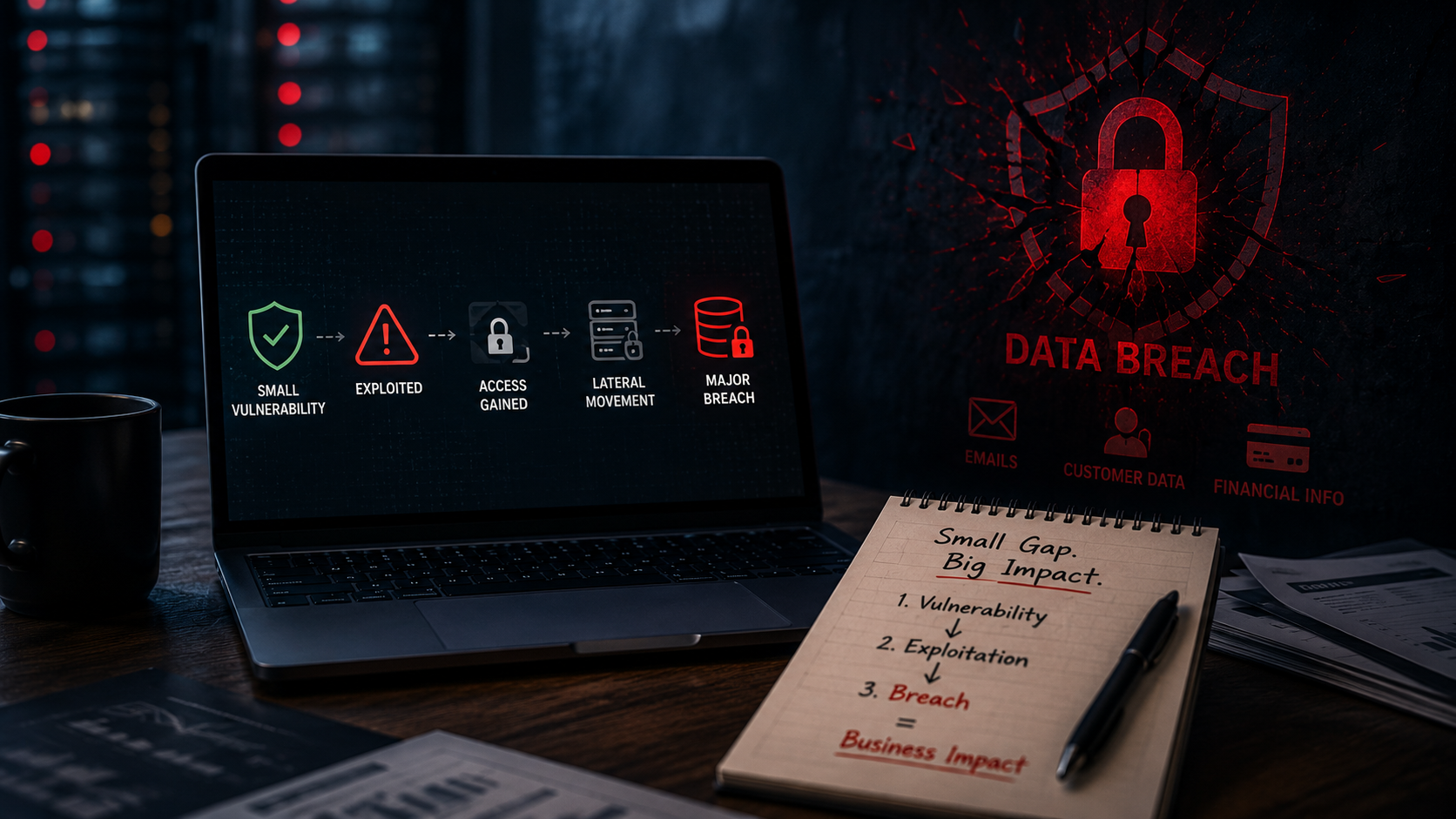
Most cyberattacks don’t start with sophisticated zero-day exploits.

  • They start small.
  • A missed validation.
  • An overlooked API endpoint.
  • A minor misconfiguration.

And then—step by step—attackers turn that small gap into a full-scale breach.

In this blog, we’ll walk through a realistic, real-world-inspired incident scenario (based on common breach patterns) to show:

  • How a minor vulnerability escalates into a major breach
  • The full attack chain used by attackers• Where detection and response failed
  • And how Aquiras Systems Pvt. Ltd could have prevented it

The Scenario: A “Low-Risk” API Vulnerability

A mid-sized SaaS company offers a web and mobile platform for managing customer data.

As part of their system:

  • APIs handle user data access
  • Authentication is token-based
  • A Security Information and Event Management system logs activity

During a routine test, a minor issue was identified.

Users could modify an ID parameter in an API request.

It was classified as:

  • Low severity
  • “No immediate impact”

And deprioritized.

The Small Vulnerability

The Issue: Broken Object Level Authorization (BOLA)

An API endpoint looked like this:

GET /api/v1/customer/1024

Authorization: Bearer <token>

By changing the ID:

/api/v1/customer/1025

The system returned another user’s data.

Why It Was Missed

  • Considered “edge case”
  • Not caught by automated scans
  • QA tested only valid user flows
  • No deep API security testing

Stage 1: Reconnaissance

Attackers begin by understanding the system.

What They Do

  • Analyze API calls via browser/mobile app
  • Intercept requests using proxy tools
  • Identify patterns in endpoints

What They Discover

  • Predictable ID structure
  • Lack of strict authorization checks

At this stage, no alerts are triggered.

Stage 2: Exploitation

The attacker begins testing the vulnerability.

Actions

  • Modify user IDs in API requests
  • Access other users’ data
  • Confirm lack of authorization enforcement

Impact

  • Unauthorized data access
  • Exposure of sensitive customer information

Stage 3: Automation

Once validated, the attacker scales the attack.

Actions

  • Write scripts to enumerate thousands of IDs
  • Extract bulk data
  • Build a dataset of user information

What’s Missing?

Despite abnormal activity:

  • No rate limiting
  • No anomaly detection
  • No alerts triggered in the SOC

Stage 4: Privilege Escalation

The attacker finds additional weaknesses.

Discovery

  • Admin API endpoints follow similar patterns
  • Weak access control validation

Exploit

  • Manipulate tokens or requests
  • Gain elevated privileges

Stage 5: Lateral Movement

With elevated access, the attacker expands control.

Actions

  • Access internal systems
  • Explore databases
  • Identify sensitive assets

Result

  • Full visibility into customer data
  • Access to critical systems

Stage 6: Data Exfiltration

Now comes the actual breach.

Actions

  • Export large volumes of data
  • Transfer to external servers
  • Avoid detection by throttling requests

Impact

  • Massive data leak
  • Regulatory violations
  • Reputation damage

Stage 7: Delayed Detection

Weeks later, the breach is discovered.

How?

  • Customers report suspicious activity• Internal audit detects anomalies

What Failed?

The Security Information and Event Management system:

  • Logged activity
  • But failed to correlate events
  • Generated alerts that were ignored

Where Detection Failed: SOC Gaps

This breach wasn’t just a vulnerability problem—it was a detection failure.

1. Lack of Contextual Monitoring

The SOC saw:

  • API requests
  • Data access logs

But didn’t understand:

  • Abnormal patterns
  • Unauthorized behavior

2. Alert Fatigue

Thousands of alerts were generated—but:

  • Analysts ignored low-priority alerts
  • No prioritization mechanism existed

3. No Threat Hunting

The team relied only on:

  • Automated alerts

No proactive investigation was conducted.

4. No API-Specific Monitoring

Traditional monitoring focused on:

  • Infrastructure• Web traffic

But ignored:

  • API abuse patterns

5. Delayed Response

Even when anomalies were noticed:

  • No immediate action was taken
  • Incident response was slow

The Root Cause: Multiple Small Failures

This breach wasn’t caused by a single issue.

It was a combination of:

  • A minor API vulnerability
  • Weak QA processes
  • Lack of security testing
  • Poor monitoring
  • Ineffective response

How This Breach Could Have Been Prevented

Let’s break down how a modern security approach would have stopped this attack.

1. Deep API Penetration Testing

A proper pentest would have:

  • Identified BOLA vulnerability
  • Tested authorization thoroughly
  • Assessed data exposure risks

The issue would have been flagged as critical, not low.

2. Security-Focused QA Testing

QA teams could have:

  • Tested ID manipulation
  • Validated authorization logic
  • Simulated abuse scenarios

The vulnerability would have been caught before release.

3. Rate Limiting & Monitoring

Implementing:

  • Rate limits
  • API usage monitoring

Would have:

  • Prevented mass data extraction
  • Triggered alerts early

4. Advanced SOC Monitoring

A mature SOC would:

  • Detect abnormal access patterns
  • Correlate events across systems
  • Prioritize critical alerts

5. Continuous Security Testing

Instead of a one-time pentest:

  • Ongoing testing would detect evolving risks
  • New vulnerabilities would be identified quickly

6. Red Team Simulation

A red team exercise would:

  • Simulate attacker behavior
  • Chain vulnerabilities
  • Expose real-world risks

How Aquiras Systems Pvt. Ltd Prevents Such Breaches

Most providers focus on isolated services—testing, monitoring, or compliance. Aquiras Systems Pvt. Ltd takes a holistic approach that eliminates gaps across the entire attack lifecycle.

1. Real-World Penetration Testing

Aquiras goes beyond basic scanning:

  • Deep API testing
  • Business logic analysis
  • Attack chain simulation

This ensures even “low-risk” issues are properly evaluated.

2. Security-Driven QA Integration

Aquiras integrates:

  • QA testing
  • Security validation

Ensuring vulnerabilities are caught during development—not after deployment.

3. Advanced SOC Capabilities

Aquiras enhances detection by:

  • Implementing intelligent alert correlation
  • Reducing false positives
  • Enabling faster response

4. Continuous Security Assessment

Aquiras provides:

  • Ongoing testing
  • Continuous monitoring
  • Adaptive security strategies

5. API & Cloud Security Expertise

Aquiras specializes in:

  • API vulnerability detection
  • Cloud misconfiguration analysis
  • Modern application security

6. Proactive Threat Hunting

Instead of waiting for alerts, Aquiras:

  • Actively searches for threats
  • Identifies suspicious patterns
  • Stops attacks early

7. Business-Focused Risk Prioritization

Aquiras doesn’t just report vulnerabilities—it explains:

  • Real-world impact
  • Exploitability
  • Business risk

Key Takeaways

This incident highlights a critical truth:

There are no “small” vulnerabilities—only underestimated ones.

To prevent similar breaches, organizations must:

  • Take API security seriously
  • Integrate QA and security testing
  • Move beyond automated tools
  • Invest in continuous monitoring
  • Adopt real-world attack simulations

Final Thoughts

Cybersecurity isn’t about checking boxes—it’s about understanding how attackers think and act.

The difference between a minor issue and a major breach is:

  • Context
  • Detection
  • Response

Organizations that fail to connect these dots remain vulnerable.

Don’t Let a Small Gap Become a Big Breach

If your organization relies on traditional pentesting or basic monitoring, you may already have hidden risks.

Aquiras Systems Pvt. Ltd helps you identify, prioritize, and eliminate vulnerabilities before attackers can exploit them.

aquirasReal Incident Breakdown: How a Small Vulnerability Led to a Major Breach
read more